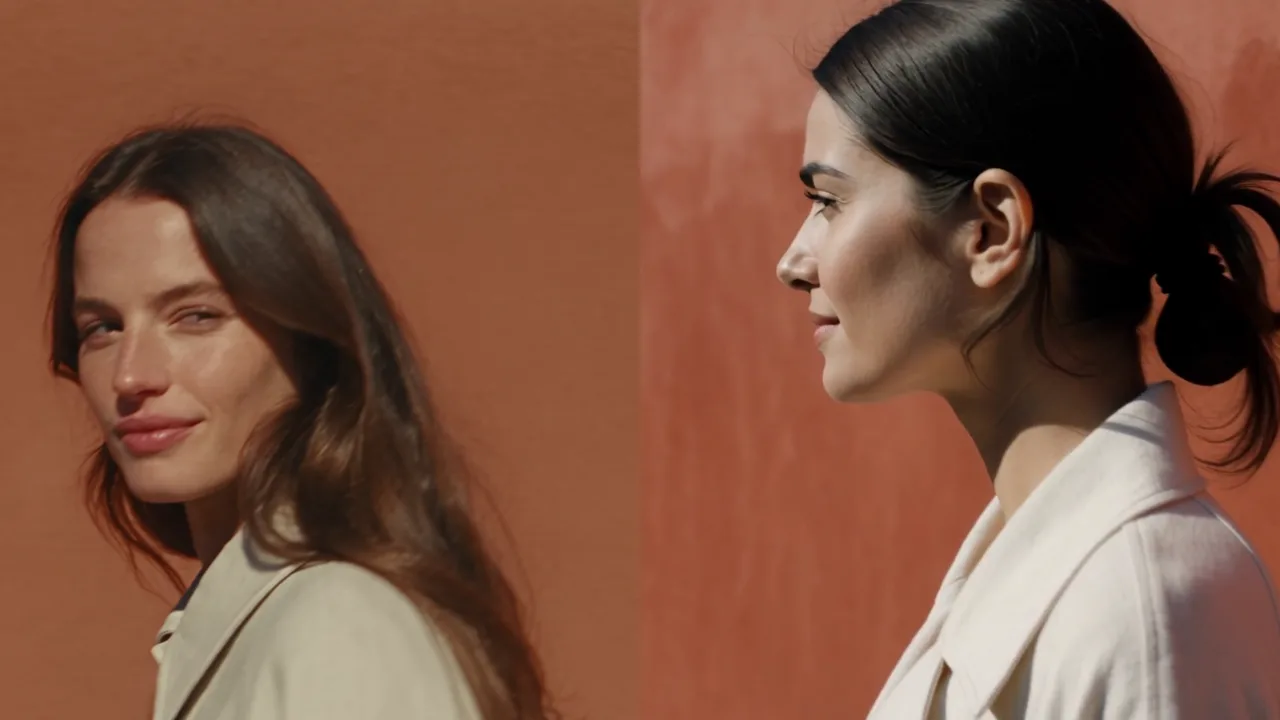
Seedance 2.5 won 4 of our 8 same-prompt tests, Kling 4.0 won 3, and one was a tie, while Kling cost about 42% as much per clip at 1080p. Kling followed camera moves and small actions more literally: the arc to a profile, the quarter turn around a product, the watch held to an ear. Seedance kept the subject and the style closer to the prompt: no invented costume on the clay fox, a readable cockpit and sparks in the chase, and blue water where we asked for it.
Both models are in ChatCut, so we could give them the identical prompt, length, aspect ratio and resolution, and read the cost of each clip from the same credit bill. Every result is below, side by side.
Key Takeaways
- Close overall. 4 wins for Seedance 2.5 (one narrowly), 3 for Kling 4.0 and a tie. Neither failed a test outright.
- Kling is the more literal camera operator. It did the arc to a profile and the orbit around the bottle that Seedance only half did.
- Seedance stays closer to the brief. Kling added a coat to the clay fox and lost the bike in the first-person shot; Seedance kept both as written.
- Both can talk. Each spoke the full line “Listen. It’s running again.” inside the 3–6 second window we gave it.
- Kling is much cheaper at 1080p. 11.28 credits for 10 seconds against 26.89 for Seedance 2.5. Seedance at 720p (10.87) costs about the same as Kling at 1080p.
Seedance 2.5 vs Kling 4.0: the scorecard
| Test | What we judged | Seedance 2.5 | Kling 4.0 | Winner |
|---|---|---|---|---|
| 1. Human motion | Walk, wind in the coat, arc to a profile close-up | Natural walk; ends three-quarter, not profile | Walk, stop and a true profile close-up | Kling |
| 2. Liquid | Strands that stretch, fold and pool | One continuous shot, folds on the comb | Smooth strand, then an unrequested cut closer | Seedance |
| 3. Dialogue | Full line on time, reaction, props | Line on time; tearful reaction; watch not at her ear | Line on time; watch held to her ear as written | Kling |
| 4. Camera | Glide, landing, pull-back reveal | All three beats; owl still visible at the end | All three beats; owl almost lost in the wide | Tie |
| 5. Multi-shot | Three shots, same rider and bike | Cockpit POV with sparks, then outside, then aerial | POV shows no bike; side shot and aerial fine | Seedance |
| 6. Product | Camera orbit, rigid product, no text | Bottle rigid but the camera barely moves | Clear quarter orbit revealing the loop | Kling |
| 7. Animation | Clay texture, one fox, leap | Clay fox as described, clean leap | Clay look, but the fox wears a blue coat | Seedance |
| 8. Crowd | Herd without merging, spray, colour | Orange spray on blue water, as asked | Strong silhouettes; everything gold | Seedance, narrowly |
How we ran the tests
- Same input. Each test used one text prompt, identical for both models, with no reference images, so neither model had an advantage from its reference handling.
- Same settings. 16:9, 1080p, and the same length per test (5 to 10 seconds), generated in ChatCut. Seedance 2.5 and Kling 4.0 both returned 1920 × 1080, 24 fps files with sound.
- One take each. We judged the first result and did not reroll.
- One side reused. To keep the bill down, five tests reuse a clip from our Seedance 2.5 or Kling 4.0 model pages and only generate the other model’s side. Those page clips were chosen for display, so the reused side had a small advantage: Kling in test 1, Seedance in tests 3, 4, 5 and 8. Tests 2, 6 and 7 were generated fresh on both sides.
- Judged against the prompt. We wrote down what each prompt asked for before looking, then checked it frame by frame and listened to the dialogue test. Where a model did something nicer that we didn’t ask for, it didn’t count.
The new clips were generated on November 13, 2026. The 11 new clips cost 137.05 credits. The videos below are shown at 480p to keep the page light; the originals are 1080p.
The 8 tests, side by side
In each pair, Seedance 2.5 is on the left and Kling 4.0 on the right.
1. Human motion: a walk along a red wall
Kling wins. Both walks are natural, with the hard shadow on the wall and the coat moving in the wind. The difference is the last instruction: Kling arcs round to a clean profile close-up; Seedance pushes in and ends with her three-quarter to the lens, looking almost at the camera. If the final framing matters, Kling did what the words said.
2. Liquid: honey on the comb
Seedance wins, narrowly. Both make convincing honey. Seedance keeps one shot and shows what the prompt asked for: the strand landing, folding over itself and building a glossy mound on the cells. Kling’s strand is smooth and well lit, but halfway through it cuts to a closer macro shot the prompt didn’t ask for.
3. Dialogue: one line and a reaction
Kling wins on the details. Both say the whole line in the right window: we transcribed both clips, and the line runs from 4.2 to 6.1 seconds in Seedance’s and from 3.1 to 5.6 seconds in Kling’s. Seedance gives the stronger performance, with tight close-ups and a reverse shot over his shoulder where her eyes do fill with tears. But it skipped “holding the watch to her ear”, and Kling didn’t: its granddaughter lifts the watch to her ear, listens and smiles. Kling’s framing is looser, closer to a medium shot than the close-ups we asked for.
4. Camera move: an owl lands
Tie. Both hit all three beats in order: the glide with wings spread, the landing with snow coming off the branch, and the rising pull-back at sunrise. Kling’s final reveal is the more dramatic landscape, with a river valley and the sun on the horizon, but the owl becomes hard to find in it. Seedance keeps the owl readable on its branch at the end, which is what “reveal the owl small” was for.
5. Multi-shot: a chase in three cuts
Seedance wins. Seedance’s first shot is unmistakably a hoverbike: a glowing cockpit, then a shower of sparks as it skims the rail. Kling’s first-person shot is a camera flying through the canyon with no bike in it and no sparks. Both then cut outside and end on a wide aerial with the sun on the horizon, so the three-shot structure worked in both; Seedance just filled each shot with what the prompt described.
6. Product: a quarter turn around a bottle
Kling wins. This test is about the camera, and Kling makes the move: it starts on the button facing the lens and orbits until the carry loop comes into view on the side. Seedance renders a clean, rigid bottle with no printing, but the camera barely drifts and the loop is visible from the first frame, so there is nothing to reveal. For product turntables, Kling followed the instruction more closely.
7. Stylised animation: a clay fox
Seedance wins. Both look handmade, with lit windows and a tracking camera. Seedance’s fox is a plain clay fox, as written, and clears the gap between roofs. Kling dressed the fox in a blue coat nobody asked for. A small liberty, but in a brand or character piece it’s the kind that costs a reshoot.
8. Crowd: wild horses at sunset
Seedance, narrowly. Both herds gallop without horses merging, and both rise into a convincing aerial. The prompt asked for orange spray against deep blue water; Seedance kept that contrast, while Kling turned the whole frame gold, which is beautiful but less like the brief. Kling’s silhouettes against the sun are the more striking image.
What does each clip cost?
| Clip | Seedance 2.5 | Kling 4.0 |
|---|---|---|
| 5 s at 1080p | 13.50 credits | 5.64 credits |
| 6 s at 1080p | 16.18 credits | 6.77 credits |
| 10 s at 1080p | 26.89 credits | 11.28 credits |
| 10 s at 720p | 10.87 credits | 7.54 credits |
| 10 s at 480p | 4.84 credits (a draft you can finish at 1080p) | Not offered |
| All 8 tests at 1080p | 180.31 credits | 75.58 credits |
Prices are ChatCut quotes from November 13, 2026. At ChatCut’s plan prices of roughly $0.18 to $0.25 per credit, a 10-second 1080p clip is about $4.72 to $6.72 on Seedance 2.5 and $1.98 to $2.82 on Kling 4.0.
The gap narrows in practice. Seedance 2.5’s 480p draft costs 4.84 credits for 10 seconds and can be turned into the 1080p final of the same shot within 7 days, so you only pay full price for takes you keep. Kling 4.0 has no draft route; its cheaper option is Kling 4.0 Flash at 720p, which is a separate model, so a Flash take you like has to be generated again on Kling 4.0 for 1080p. Our Seedance 2.5 price guide works through when drafting saves money.
How long did they take? We submitted all 11 new clips at once. The first two Seedance clips were back in under 3 minutes and everything was done within about 10, but several jobs queued behind others, so treat that as an upper bound, not a speed test.
Seedance 2.5 vs Kling 4.0 specs
| Seedance 2.5 | Kling 4.0 | |
|---|---|---|
| Clip length | 4–30 s | 3–30 s |
| Resolution in ChatCut | 480p (draft), 720p, 1080p | 720p, 1080p |
| Aspect ratios | 16:9, 9:16, 1:1, 4:3, 3:4, 21:9 | 16:9, 9:16, 1:1, 21:9 |
| Image references | Up to 30 | Up to 10, frames included |
| Video references | Up to 10 | Up to 5 |
| Audio references | Up to 10 | None |
| Frames | First and last frame, not combined with references | First, last and middle keyframes, combined with references |
| Sound | Generated with every clip | Generated with every clip |
| Edit or extend a video | Yes, as Edit and Extend modes | No dedicated mode; reference videos guide a new clip |
Two differences matter most when you choose. Seedance 2.5 takes audio files as references, so a voice or a music track can drive the clip, and it can edit or extend an existing video. Kling 4.0 can mix frames and references in one request and pin images to set seconds, which suits shots that must pass through exact poses. The Seedance 2.5 and Kling 4.0 pages have the full input lists.
What other testers found
Our 8 tests are a small sample, and other comparisons point the same way. CellCog’s 10 tests scored the two within a few points, with Seedance 2.5 taking 7 tasks and Kling 4.0 winning on a pancake flip, a shop sign and a car’s direction of travel. PhotoGPT’s 8 tests found Kling clearly better at complex on-screen typography. Comparisons of the previous generation, such as Filmora’s Seedance 2.0 vs Kling 3.0, gave Seedance the edge on lip sync and Kling the edge on camera work. That fits what we saw: Kling for literal camera and object direction, Seedance for subject fidelity and style.
Which should you use?
- Product turntables, exact camera moves, on-screen text: start with Kling 4.0. It followed our camera directions more literally and costs less per take.
- Character, style and brand consistency: start with Seedance 2.5. It kept the clay fox, the bike and the colour brief as written, and its 30-image reference limit gives you more ways to pin a look.
- Dialogue: both deliver lines on time. Seedance gave the stronger performance in our test; Kling followed the staging more closely. Try your scene on both.
- Music- or voice-driven clips: Seedance 2.5, because it takes audio references.
- Budget-first drafts: Seedance 2.5 at 480p if you want to finish the same take at 1080p; Kling 4.0 Flash at 720p if 720p is the final.
In ChatCut you don’t have to choose once. Both models sit in the same model menu, so you can generate a shot on each, put the takes side by side on the timeline and keep the better one. For prompts that work well on Seedance, see our 22 tested Seedance 2.5 prompts; for a step-by-step walkthrough, see how to use Seedance.