“I’ve posted 60 Shorts in 90 days, hit 8,200 subscribers, and made $47.”
A creator on r/NewTubers posted that math a few weeks ago, and the responses underneath split into two camps. The first camp told her to grind harder, post twice a day instead of once. The second camp gave her the answer that the SERP for “how to make YouTube shorts” almost never gives: the $47 isn’t broken Shorts revenue. It’s working Shorts revenue. Shorts pay between three and ten cents per thousand views in 2026, so one million Shorts views earns $30 to $100 (vidIQ YouTube Shorts monetization 2026). The 8,200 subscribers are where the money lives, because the same niche on long-form pays $25 to $50 CPM (Affinco YouTube statistics 2026).
That misreading is the most common mistake in 2026 Shorts production. Every “how to make YouTube Shorts” article ranks five tips (hook, captions, length, cadence, trending sounds), and not one of them places those tips inside the actual business model. This piece does. It walks through the six decisions that ship a Short (first frame, structure, length, captions, cadence, metadata) with the 2026 numbers attached, and ends on the production stack that lets one shoot day become seven Shorts without the burnout that kills most channels by week six.
The first frame matters more than the first three seconds
The “hook in the first three seconds” rule is everywhere in 2026 Shorts advice. It was correct in 2022. In 2026 it’s directionally right and tactically late.
The Shorts algorithm samples completion behavior in the first 0.8 seconds to classify a video into a seed audience. Viewer self-selection happens in the first three seconds. Those are two different windows with two different jobs. The first decides whether your Short gets seen; the second decides whether the viewer who saw it stays.

A documented A/B from May 2026 makes the distinction concrete. On-screen text promising a payoff within the first 100 milliseconds, combined with a small jump-zoom and a one-frame timer overlay, lifted three-second hold from 54 percent to 71 percent. Completion rate climbed 48 percent (Vidocu tutorial-video case study). The hook isn’t a line spoken in the first three seconds. It’s a piece of on-screen text that loads in the first frame.
Treat the first frame as advertising real estate. Four to seven words, high contrast, top safe zone, payoff stated outright. The audio comes later.
Structure: hook, then payoff, then a single-word CTA
The advice to “use a CTA” is also everywhere and also mostly wrong. Generic “what do you think?” prompts earn polite scrolling. A keyword CTA (asking viewers to comment a specific word, like “comment LINK for the doc”) lifts comment counts 1.5 to 2.2 times against the generic version (TerraMarket short-form hooks). The mechanism is automation: the keyword triggers a DM flow, the viewer gets the promised asset, the algorithm reads a comment uptick.
The structure that actually ships in 2026 is a three-beat sequence. Three seconds for the hook, twenty seconds for one specific payoff (a single insight, a single tutorial step, a single observation), and seven seconds for the keyword CTA tied to a follow-up asset. The fail mode is the inverse: thirty-second payoff, no CTA, no comment lift, no algorithm signal that the video performed.
The length sweet spot is shorter than the cap
YouTube Shorts can be up to three minutes since the October 2024 expansion. The sweet spot for retention sits between fifteen and forty-five seconds. Sixty-five percent of viewers finish videos under sixty seconds, and the completion curve drops sharply past that mark (RecurPost step-by-step Shorts guide).
Three-minute Shorts work for one category: tutorial-density topics where the viewer is committed to the payoff before the click. A productivity creator showing a complete keyboard-shortcut workflow can hold a viewer for three minutes. A fitness creator demonstrating a single exercise cannot.
If you’re not sure which side you’re on, ship at thirty seconds and iterate. Length is the easiest variable to test against your specific audience, and the cost of testing is zero.
Captions are a floor, not a tactic
This is the cheapest section to write because the data is unambiguous. Eighty-five percent of social video is watched without audio in 2026 (OpusClip Facebook Reels captions). Layering visual, textual, and auditory hooks triples three-second hold compared with single-element openings (TrueFan silent-video hooks).
Burned-in captions, four to seven words per line, top or bottom safe zone, high contrast. SRT files uploaded separately do not capture sound-off scroll behavior. The captions have to be visible without the viewer enabling anything.
Treat this as a floor by 2026. There is no “when not to use burned-in captions.” Every Short ships with them or skips the half of the audience that watches with sound off.
Cadence: daily, but not from fresh shoots
The volume math is straightforward. Daily posting generates three to five times more algorithmic distribution than weekly posting (Miraflow viral Shorts guide 2026). The algorithm reads consistency as a quality signal, and the seed-audience surface refreshes daily.
The trap is treating “daily posting” as “daily shooting.” A creator who shoots a Short every morning burns out in six weeks. The Reddit consensus on r/NewTubers and r/PartneredYoutube is the same one Miraflow surfaced: every successful Shorts channel runs a creator stack, a set of tools and a workflow that turns one shoot day into seven Shorts (MilX YouTube monetization 2026).
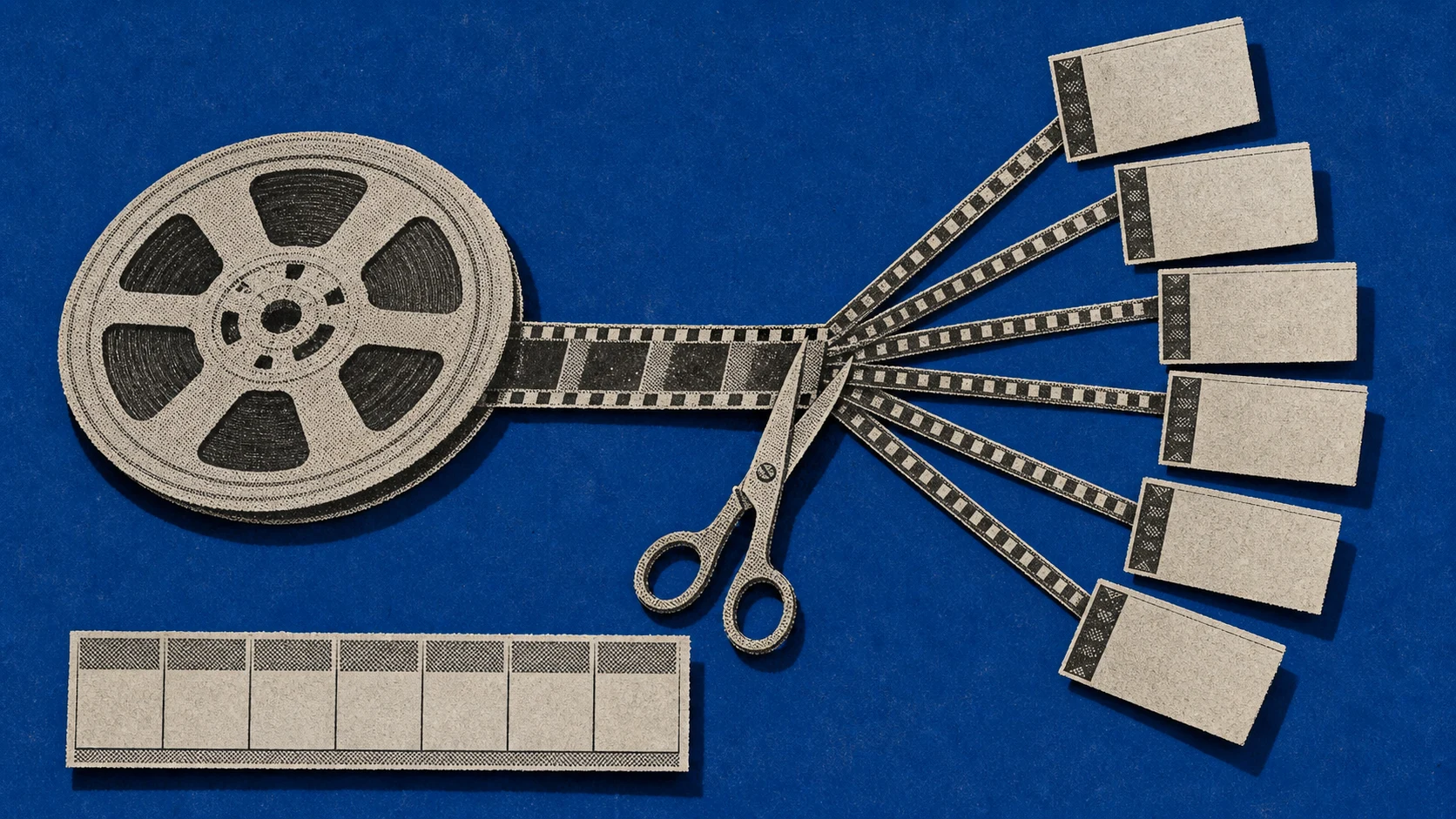
That stack typically looks like this. Shoot a 45-minute source recording once a week: a Q&A, a tutorial walk-through, a podcast appearance, a long-form explainer. Cut seven 30-second Shorts from the transcript. Each cut gets its own first-frame hook, its own caption pass, its own keyword CTA. The shoot day is the asset; everything after is editing labor.
This pattern is also the reason most Shorts advice is wrong about what creators need to learn. The skill that grows a channel in 2026 isn’t camera operation or lighting setup. It’s identifying the 30-second moment inside a longer recording that earns the click.
The metadata still matters (more than the listicles claim)
Five of the top-ten “how to make YouTube Shorts” articles claim that title, description, and tags don’t matter for Shorts because “the algorithm is feed-driven.” This is half-right.
The algorithm does serve Shorts feed-first, not search-first. But the topic-classification step that runs before the seed-audience match still pulls signal from the title, description, and the first frame’s on-screen text. A Shorts title written for a human reader, with a clear topic phrase, also serves as a classification anchor. Treat the title the way a long-form creator does, even though the click mechanic is different.
A description tip that the listicles miss: the first sentence of the Short’s description is read by the topic classifier with high weight. Putting your topic and one keyword in that first sentence is free signal.
The 2026 trap to avoid
YouTube’s January 2026 enforcement wave is the platform shock most 2024 Shorts playbooks haven’t priced in. The platform wiped 4.7 billion views and demonetized sixteen channels with a combined 35 million subscribers, all of them running the same pattern: AI-generated scripts read by AI voices over stock B-roll, no human creator visible (ScaleLab on YouTube’s 2026 AI-content crackdown).
That pattern is the bottom line for AI in Shorts production. AI is the right tool for editing real footage you shot: transcript-based clip selection, automated caption burn-in, alternate-hook generation from a single source. It is the wrong tool for generating the whole thing from a prompt and stitching it together with stock footage. The first lane builds a channel; the second lane gets the channel demonetized.

What ChatCut does (and doesn’t do) in this stack
The Shorts stack has four pieces. A camera or screen recorder for the source shoot, an editor for the cut, a captioning layer, and a scheduling tool. ChatCut sits in the editor slot, with the captioning layer built in.
The workflow looks like this. Upload the 45-minute source recording to text-based editing. The transcript appears alongside the video. Pull seven 30-second cuts by editing text instead of scrubbing through frames. “Find the moment she explains why most Shorts fail.” “Pull the 20 seconds where I demonstrate the keyboard shortcut.” “Cut every pause longer than half a second across all takes.” Captions burn in automatically in the 4-to-7-word line spec. Each cut gets its own first-frame text hook, written into the timeline as a prompt rather than placed in an animation panel. You describe the edit. ChatCut executes it.
The boundary lines are honest. ChatCut is not a YouTube uploader; the file leaves the editor as a 1080p MP4 and you upload from YouTube Studio. ChatCut is not a thumbnail generator; the AI image generator can produce a reference frame, but custom-illustrated thumbnails still want a designer. ChatCut is browser-only and runs in Chrome. Mac, Windows, Chromebook, Linux all work without installation. Free includes twenty one-time credits to test the workflow. Outputs from any tier ship without a watermark.
The deeper resource for the long-source-to-cuts pattern is turn long videos into shorts; the YouTube-specific editor lane is covered in best AI video editor for YouTube. For the broader social-media-content workflow this stack feeds, social media content production and talking-head editing are the natural extensions.
Five questions, five direct answers
Why is my Shorts revenue so low? Because Shorts revenue is supposed to be low. Three to ten cents per thousand views is the published 2026 RPM range. Shorts exist to feed long-form, sponsorship, and product channels where the actual revenue lives.
Daily posting or weekly? Daily, from a weekly source shoot. The cadence the algorithm rewards is daily; the cadence a human can sustain is weekly. A creator stack reconciles the two.
Are burned-in captions optional? No. Eighty-five percent of social video is watched without audio. Burned-in captions are a floor by 2026.
Should I be using AI to generate Shorts? Yes for editing real footage you shot: transcript editing, captions, hooks, variants. No for generating the whole thing from a prompt and stock B-roll. The January 2026 demonetization wave was specifically the second pattern.
What’s the worst mistake a new Shorts creator makes? Optimizing for Shorts revenue directly. The math doesn’t work and never will. Optimize for subscribers who then watch long-form, where the revenue mechanic is five to twenty times stronger.
Cutting seven Shorts from one shoot day this week? Try ChatCut Free. Twenty one-time credits, 1080p MP4 output, no watermark, browser-only.