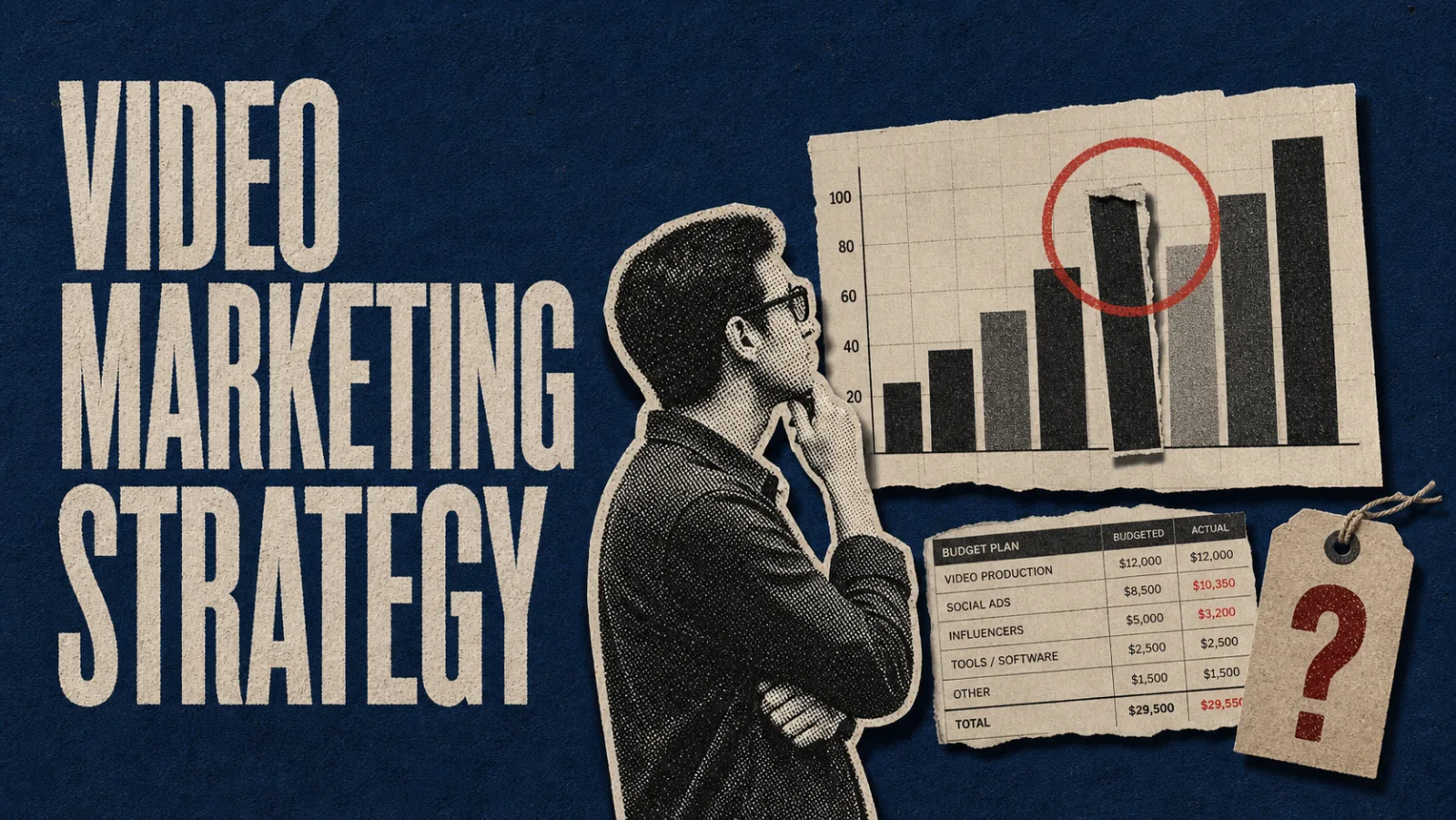
Three numbers from this year’s industry reports do not agree with each other. Ninety-one percent of businesses use video as a marketing tool (Wyzowl State of Video Marketing 2026). Eighty-two percent of marketers report good ROI from video, down from 93 percent in 2025 (Wyzowl). And only 37.1 percent of marketers plan to increase video investment in 2026, down from 57 percent in 2023 (HubSpot 2026 State of Marketing, n=1,500+, published April 10, 2026).
The most expensive question in 2026 marketing strategy is what those three numbers mean together.
Adoption peaked. ROI satisfaction is softening. Budget growth is decelerating. Meanwhile, AI tools are compressing production costs by a factor of ten, audiences are starting to refuse AI-generated content at the platform-policy level, and 88 percent of US connected-TV inventory is now programmatic (eMarketer Digital Video Forecast Q2 2026). The video budget that worked in 2022 is now mispriced in three specific ways. This is a framework for fixing each one.
The four levers of a 2026 video marketing budget
A CMO’s video budget allocation reduces to four decisions, in this order of consequence:
- Production allocation (how much, in-house vs agency vs AI-assisted)
- Format mix (short-form, long-form, live-stream)
- Distribution layer (organic, paid social, CTV, creator partnerships)
- Measurement model (attribution-based ROI vs brand-level metrics)
Most 2024-2025 budgets over-indexed on production and under-indexed on distribution. The 2026 data suggests that’s now backwards.

The sections below run each lever against the freshest available benchmarks.
Production allocation: AI is now a default, but adoption is hiding a quality split
Eighty-six point four percent of marketing teams now use AI in at least one workflow, and 74 percent specifically use AI to create or edit video (HubSpot 2026). Wistia’s 2026 State of Video report (13 million videos and 79 million hours analyzed, published April 22, 2026) finds that over one-third of video teams use AI, and daily video producers are 58 percent more likely to use AI than monthly producers (Wistia State of Video 2026). Teams using AI are twice as likely to produce 100-250 videos per year as teams that don’t.
The headline numbers tell one story: AI compresses pre-production, repurposing, and editing time, and the teams that adopt it ship more output. The footnotes tell another. Consumer preference for AI-generated creator content fell from 60 percent in 2023 to 26 percent in 2025 (Billion Dollar Boy data, via Digiday on the AI backlash). Eighty-three percent of consumers report they can identify AI-generated video, and 36 percent say they lose trust in a brand when they detect AI (MindStudio analysis of the human-content premium). YouTube wiped 4.7 billion views and demonetized 16 channels (roughly 35 million subscribers combined) in its January 2026 enforcement wave against AI-generated content at scale (ScaleLab on YouTube’s 2026 crackdown).
The strategic read for production allocation in 2026: AI is the right tool for utility video (internal training, course content, repurposing existing footage into platform variants, translation and localization at scale). AI is increasingly the wrong tool for the brand-facing, audience-acquisition layer of the funnel. The premium for human-recorded content is now measurable at the audience level and is being priced in at the platform level.
The cleaner way to think about it: prompt-driven AI editors belong in the post-production layer of the human-recorded asset, not in the generation layer.

Skip the menus. Type what you need. A founder’s 90-minute on-camera interview is the scarce input; the question is how cheaply you can cut it into platform variants and reuse it across surfaces. That lane is what text-based editing and the broader talking-head editing workflow are actually for. AI generation, by contrast, produces the supply that the audience signal is now penalizing.
The proposed budget reframe: cap AI-driven production at internal and utility output. Reserve human-recorded production budget for two to four flagship brand stories per quarter that lean into the qualities AI cannot replicate (specific personalities, unscripted moments, accountability to a named subject). The total production line item drops; the relative spend on human-recorded video rises.
Format mix: the long-form rebalance is real
For three years, “everything is fifteen seconds” was the operating assumption. The 2026 data is moving away from it.
HubSpot’s 2026 report ranks short-form video as the highest-ROI content format for 48.6 percent of marketers; long-form ranks for 28.6 percent and live-stream for 25.1 percent (HubSpot 2026). Wistia finds that videos under 60 seconds average a 52 percent engagement rate, and the 3- to 30-minute band performs best when audiences are in “research mode.” Sprout Social’s 2026 Index reports short-form video delivers the highest ROI of any social format (41 percent), but the platform-by-platform breakdown is more interesting: 52 percent of Instagram users and 48 percent of Facebook users interact most with short-form, while only 27 percent of LinkedIn users do (Sprout Social 2026).
The platform-side signal corroborates the rebalance. TikTok raised its post limit to 30 minutes and has reported that roughly half of TikTok watch-time is now on videos over 60 seconds. Instagram Reels extended uploads to 15 minutes (and up to 20 minutes for select accounts). YouTube Shorts expanded to a three-minute cap in October 2024. These are not platforms anticipating shorter content; they are platforms positioning for a longer-form pivot.
The strategic read on format mix: a portfolio. Short-form for awareness and paid acquisition (still the high-volume top of funnel, the lane covered in detail by the social media content workflow), long-form (5 to 12 minutes) for the consideration layer where buyers are actively researching, and live-stream for the high-trust moments where authenticity is the value (product launches, founder Q&As, customer storytelling). The 2024 default of “if it’s longer than 60 seconds, cut it down” is now an outdated heuristic for the consideration funnel.
Distribution layer: where most CMO budgets are still wrong
The single biggest 2026 strategic shift sits here, and the SERP isn’t writing about it.
LinkedIn is now the most important B2B video channel by a significant margin. Ninety-three percent of B2B marketers use LinkedIn, and 75 to 85 percent of B2B social leads originate there (Socialinsider LinkedIn benchmarks 2026). But organic LinkedIn video views are down 36 percent year-over-year across every page size, and carousels are now outperforming video on engagement by roughly 278 percent. The LinkedIn paradox: it’s the most important B2B channel and one of the worst organic video channels. The implication is that LinkedIn video is now a paid-plus-thought-leader hybrid play, not an organic distribution channel.
Connected TV is moving from emerging surface to default budget line. US CTV ad spend will hit $37.95 billion in 2026, up 14.5 percent year-over-year, and the CTV upfront ($17.73 billion) overtook linear primetime upfront ($16.98 billion) for the first time. Eighty-eight percent of CTV inventory is now programmatic. For brands accustomed to paid social as the primary video distribution surface, the CTV programmatic layer is a tier shift in efficiency that should be measured against social CPM, not against linear TV CPM.
The creator economy is the third distribution lever. Goldman Sachs projects the creator economy total addressable market to grow from $250 billion today to $480 billion by 2027 (Goldman Sachs creator economy outlook). Influencer marketing alone is expected to reach $40.5 billion in 2026 (Mordor Intelligence). The shift inside this number that matters for strategy: the creator economy is increasingly a distribution expense for brands rather than a content production expense. Brands are buying access to the creator’s audience, not asking the creator to make content the brand could have made itself.
The proposed distribution reframe: move 10 to 20 percent of production budget into distribution.

The marginal video produced in 2026 is competing for a fixed amount of attention, and the underpriced asset is the channel that puts the video in front of the right audience, not the second incremental video.
Measurement: where most attribution models break
The 82 percent ROI satisfaction number that’s down 11 points from 2025 is partly a measurement story.
View-through attribution overstates video’s role. Multi-touch attribution understates it. Last-touch attribution misses it almost entirely. The marketing reports that show video ROI dropping are mostly measuring last-touch and view-through windows that are getting shorter as cookies disappear. The reports that show video’s strategic value are mostly measuring brand-level metrics like share-of-voice and share-of-search.
Les Binet’s work at the IPA on share-of-search has become the most cited alternative measurement model in 2025-2026 B2B circles. The basic claim: branded search volume tracked over time is a leading indicator of brand-driven revenue, and video’s contribution to brand-driven revenue shows up there 60 to 90 days after a campaign in ways it doesn’t show up in performance attribution. The IPA’s published research on share-of-search as a campaign measurement signal (IPA effectiveness research) is now standard reading for CMOs who suspect their attribution-driven video reports are systematically underestimating brand contribution.
The strategic read on measurement: assume your video ROI report is wrong, especially if it’s based on view-through or last-touch. Run share-of-search and assisted-conversion measurement alongside attribution-based ROI for at least one full campaign cycle. If the two measurement models disagree by more than 30 percent, the brand-level metrics are usually closer to the truth.
The audience-side AI backlash and what it implies for budget
The most under-discussed 2025-2026 strategic shift: audiences are now actively penalizing brands that ship AI-generated video, and platforms are starting to enforce it.
The Billion Dollar Boy preference data (60 percent → 26 percent in 24 months) is the lagging indicator. The leading indicator is the platform behavior. YouTube’s January 2026 enforcement wave against AI-generated content at scale represents the first major platform to monetize the scarcity of human-recorded video at the policy level. Meta’s July 2025 originality enforcement on Facebook and Instagram does the same for cross-posted AI content. TikTok’s increased weight on completion rate and rewatch in 2026 implicitly rewards content that holds attention, which AI-generated content does less effectively in head-to-head testing.
The brand-level implication: human-recorded content is now an underpriced asset relative to its scarcity. The brands that invest in two flagship human-recorded brand stories per quarter, with named participants and verifiable production provenance, will see two compounding tailwinds: audiences increasingly favoring identifiable human content, and platforms increasingly suppressing identifiable AI content. The 2026 budget should treat human-recorded as a premium asset, not a default one.
A contrarian thesis for 2026-2027
Most 2026 video marketing budgets are mispriced in two specific ways: too much spent on production, and within production, too much spent on AI-generated volume rather than human-recorded scarcity.
The contrarian thesis: the marginal dollar in a 2026 video budget should move from production to distribution, and within production from AI-generated volume to human-recorded brand stories. The supporting evidence is the triangle of (a) production cost collapse (74 percent of teams now use AI, supply is exploding), (b) attention saturation (LinkedIn organic video views down 36 percent YoY, every platform’s effective organic reach declining), and (c) audience preference signal (consumer preference for AI creator content from 60 percent to 26 percent in 24 months).
The actionable form: cap AI production at internal and utility output, reserve human-recorded budget for the brand-acquisition layer at two to four flagship videos per quarter, and reallocate 10 to 20 percent of total video budget from production line items to distribution line items (CTV programmatic, paid LinkedIn, paid creator partnerships).
The falsifiable prediction for 2026-2027: brands that label and verify human-recorded provenance on their video content will see at least 15 percent higher engagement on LinkedIn organic by Q2 2027, and at least 10 percent higher share-of-search lift from the same content compared to AI-generated equivalents. If neither of those moves, the thesis is wrong and AI-generated content is still good enough that audience preference isn’t translating to measurable brand outcomes. The bet is that both move.
Five strategic questions for the next quarterly review
These are the questions that re-examine the 2026 video budget against the framework above. Not tactical questions about which platform to use; allocation questions about where the budget is currently mispriced.
-
What percentage of our video production budget went to AI-generated output last quarter, and how much of that output is consumer-facing versus internal? If consumer-facing AI output exceeds 30 percent of production, the audience backlash data argues for a reallocation.
-
What is our distribution-to-production ratio? If the production line item is more than 5x the distribution line item across CTV, paid social, and creator partnerships, the marginal dollar is in the wrong place for 2026.
-
Are we measuring share-of-search alongside attribution-based ROI? If only attribution metrics exist, the 11-point ROI satisfaction drop in industry data probably reflects our reports too.
-
How many human-recorded flagship videos shipped last quarter, with named participants and verifiable production provenance? Fewer than two is below the premium-content tier the audience signal now rewards.
-
What’s our format mix by content depth? If more than 80 percent of our video output is under 60 seconds, we’re probably under-investing in the consideration-funnel surfaces where 5- to 12-minute video performs best in 2026.
The 2026 video marketing strategy isn’t about choosing a platform or hitting an output target. It’s about pricing what’s gotten cheap (production volume) against what’s gotten expensive (audience attention to human-recorded content). Most 2024 budgets had those backwards. Most 2026 budgets still do.
Reallocating from AI generation to human-recorded post-production? Try ChatCut Free. Prompt-driven editing for the utility lane the strategy above keeps recommending, no watermark on the Free Plan.